I was looking back through posts from last winter, and I see that I was bothered then by many of the same things that are bothering me now—a bigger body than I’d like, a body that won’t cooperate with my desire and need to exercise, a body trying hard to recover from injury, a body that has asked me to slow the hell down so that it might try to heal. I see that my New Year's Resolutions from this past January even set more limited goals, exercise-wise, since I didn't want to go crazy with the expectations.
Last year I expected this, since I had just had surgery. I really thought that by this year I might not be feeling this way. I know that those kinds of thoughts do me in, those kinds of expectations, but they sneak their way in there before I realize it, and then I have to extricate them.
I am not complaining about my shoulder. In fact, I am trying hard not to complain. It is just that the left side of my body seems to be part of an organized revolution of some kind. Things started with that shoulder, of course. Then randomly one day, I had a blind spot in the center of my left field of vision—kind of like I had looked at a bright light, but it has never gone away. Then this summer while I was in London, my left hamstring got really tight, and no amount of stretching would help. (Mind you, this cannot be a sports injury, because all I was doing at that time was sitting in the British Library for hours on end, and walking to and from the British Library. Well, and Bollywood dancing, but I digress.) That hamstring pain came and went during the fall, but got worse in the weeks leading up to Thanksgiving, to the point where it even hurt to kick while I swam.
My coach, knowing how the pain started, suggested that I try a chiropractic adjustment. I went to see the chiropractor last week, and he asked, “Has your left shoulder always been lower than your right?” I said no, and told him the whole Shoulder Surgery Massacree, with four-part harmony, and he said, “Bless your heart,” southern U.S. code for “Your life sucks but I’d hate to say so.” He also suggested that until I see how these adjustments affect my spine, that I not do any strength training, though swimming would be fine.
Anyway, he has done some splendid crackly adjustments on my back, neck, and hips, trying to get things straightened out. But then on Wednesday of last week I went to the pool after seeing him, and as I was kicking—but not even particularly hard—I felt some kind of irksome but not particularly traumatic snap in my—you guessed it—left knee, which then got more and more painful. So after a ridiculously short swim, I got out, took a shower and went home, befuddled, and did a lot of icing.
I mean, exactly what kind of exercise can I do? Nothing that overtaxes my shoulder. Nothing that makes my hamstring or knee hurt. Nothing that might affect my spine.
That leaves . . . knitting.
Which I have been doing a lot of.
But it ain’t swimming. Or walking. Or rowing. Or cycling. Or lifting weights.
Have you tired yet of my now seemingly endless tales of exercise woes?
On Friday the PP noted that his mother and sister are getting themselves a Wii fit for Christmas, and he suggested we consider getting one. I told him maybe, but first let me put in a plea to Magpie, who is giving one away.
Will it change my life? I don’t know. I love games, and maybe having some little active games that we can play in the cold weather that still get the blood pumping would be fun. (Probably can’t knit while playing, though, without risking bodily harm to myself or the PP.) But hey—at this point I am willing to try anything!
Showing posts sorted by date for query bollywood. Sort by relevance Show all posts
Showing posts sorted by date for query bollywood. Sort by relevance Show all posts
Monday, December 08, 2008


Tuesday, July 08, 2008
All the hot girls.

There was one point today during Jay Kumar's Big Bollywood Dance Class when he yelled out to the crowd, "All the hot girls, make some noise!" and really, no one responded. He said, "Come on, you have to cheer now, because you're all hot girls, even the fellas!" and then tried again, and he did get a bit more response. But really: we were all having a great time, but did any of us actually self-identify as hot girls?
Perhaps I should back up and tell you that, as this was happening in the piazza of the British Library, his dance class was composed almost entirely of scholars and older Indian ladies. The former were on their lunch break, all deciding in unison that today was a workday like no other. The latter were there in hopes that there would be some time for some more traditional Indian dances, which there was (though for one woman, who kept going up to him as he was teaching Bollywood dance steps and asking was now the time, it could not come soon enough). We scholars were dressed in our sweaters and days-old trousers, while the Indian ladies were wearing beautiful saris with raincoats, and we were all wearing glasses.
Hot girls!
The event started with a performance by Jay Kumar's troup DanceAsia. Here is a video I found of them, though they did not have sticks at the library:
Then he got everyone out into the middle of the piazza to teach us some fairly simple (but extremely fun) steps so that we could dance to several different songs. There was a decent lot of phootographers there, too--amateur and professional--as well as a reporter from the BBC World Service, who he convinced to come up onto his platform and shake her ass, which she did with great aplomb.
If you have never seen Bollywood movies, with their enormous extravagant dance numbers, you may not know quite what I am talking about. But seriously folks, these are musicals to a new extreme--beautiful colorful costumes, elaborate scenarios, and music that makes you want to jump out of your seat. There are few situations in these films that cannot benefit from a dance number. Looking forward to a wedding? Dance. Unable to marry the man you love? Dance. Faced with a wedding you dread? Dance. Afraid of losing a cricket match and therefore all your land? Dance then too. Entire plot lines are introduced for the purpose of requiring dance numbers. And the dancing is fabulous! In fact, treated this past weekend to a vast display of fabulousness, I am still not sure that this is not MORE fabulous. Really.
(Now granted: a library piazza full of scholars in drab jumpers and older ladies in raincoats dancing in mid-summer drizzle did not look fabulous, but we FELT fabulous!)
In a way, what he was having us do was not unlike aerobic dancing or disco, except that some of the moves had a particularly Bollywood flavor. In fact, the whole experience made me wonder whether anyone has thought of structuring an aerobics class around Bollywood music and dancing. I am sure they have, but I tell you (or do I need to? You know how I love Bollywood music and films): if I could find one, I would go every day.
In a way, what he was having us do was not unlike aerobic dancing or disco, except that some of the moves had a particularly Bollywood flavor. In fact, the whole experience made me wonder whether anyone has thought of structuring an aerobics class around Bollywood music and dancing. I am sure they have, but I tell you (or do I need to? You know how I love Bollywood music and films): if I could find one, I would go every day.
Thursday, July 03, 2008
From the new BL.

If you are feeling ornery, you might try to point out to me that the British Library at St. Pancras is not that new, but to me it is, and it is my blog, dammit.
About 12 years, I spent a good bit of time working in the old British Library, located under the great dome of the British Museum. It was, after all, once called the British Museum Library, and as an institution it did not separate until 1972. Physically, the two institutions separated in 1997, when the new facility at St. Pancras opened to cheers and boos. This library is the legal deposit library for the United Kingdom , which means that a copy of every single book published in the UK and Ireland (and foreign books distributed in Britain) must be sent here. Talk about shelf space!
To get to the old British Library, you had to pass through the main doors and entryway of the British Museum. That meant climbing the impressive stone steps and making your way through hordes of visiting schoolchildren on your way to show your pass, squeeze your bag into the cloakroom, and search out a good desk, perhaps even with an outlet for your laptop.

Working under that dome was amazing: there you would be, having your serious thoughts and reading serious books in the same room where so many others had before you--Karl Marx, Virginia Woolf, Ezra Pound, George Bernard Shaw, W. B. Yeats, and on and on. Looking back on the I spent there, when I was researching for my dissertation, I do not believe I did that much work that I could not have done elsewhere, but to do it there was an experience I would not trade.
Particularly now that it is an experience never to be replicated.
Now they have converted that old space into a sort of replica of the original. The domed library is still there, with books lining it (and the same fake books disguising the doors). The architectural space around the dome, which used to serve as extremely cramped bookstacks (though it was not originally intended to do so--but the library, like so many, ran out of storage space), is now opened up to the light, and it holds a cafe. In the library itself, there are still the rays of numbered desks emanating from the central hub, and there are some books there (mostly samples of writings by important figures who used the library over the years), but it is no longer a true working space. It has become a museum of a museum.

UPDATE: It is worse than I thought.
At the time I was working there (1996 or 1997), the BL was in the process of moving itself to St. Pancras, which meant that the time between calling up a book and having it delivered was even longer than usual--and "usual" was already pretty long. An inevitable part of the BL experience, then, was waiting, and finding ways to use waiting time productively.

The new BL is, relatively speaking anyway, all about efficiency. Catalogues are now online. Materials can be reserved in advance, again online. There are outlets at every desk. There are ample lockers for securing your stuff. Book call time has dropped significantly. There is air conditioning. There is a restaurant in the building. There are limits on the number of little slips you can have at any time, so that you only submit the permitted number at one time. Everything feels spacious and light.
This time I am really using things that I can only use here--the Macmillan Publishing Company's archives, which I am consulting for another volume of my edition.
Some things have not changed. You still have to have a reader's pass to use the reading rooms, and getting such a pass requires "real reason" to use the collection and letters of reference. Getting access to manuscripts takes more letters and proof. There are still the earnest graduate students, and I can so clearly remember what it was like to see something rare or unique for the first time, something you can only see in this one place. I think I see that look on the faces of students around me, as they turn the leaves of an old manuscript.
And in the lobby areas and exhibitions spaces, there are still hordes of school-children, but now instead of being on their way to see Egyptian antiquities, they are looking at a screen that lets them "turn the pages" (virtually) of, say, the Lindesfarne Gospels, seeing larger than life and radiant with screen-light the beautiful images. (New meaning of "illuminated manuscript") Or they are listening on headphones to music from the 1968 on Record: A Year of Revolution audio exhibition.
Now there are also loads of undergraduates, apparently allowed to work here now, though in many cases their "work" looks an awful lot like the "work" students at my home institution do in that library. . . .
 In some ways, the BL has become a giant media center, as have so many libraries, with its traditional collections still here for insects like myself who burrow into the past. The King's Library is on show in a giant glass-encased column at the center of the building, so that the spines can be seen, if not touched. Most of the books are in hidden stacks underground. In the summer, there is music on the piazza.
But it is still amazing to work here, to know that just about anything can be found out here. As I look at the pencilled names on the labels on packets of page proofs, and see there one after another eminent Yeatsian, I feel both intimidated and thrilled.
And honsetly? I can hardly wait for the Big Bollywood Dance Class next Tuesday! Yeats was a big fan of India, and I know that if he were alive today, he would join me in my love of Asha Bhosle!
Wednesday, September 28, 2005
Bollywood's dark underbelly.
Or should that be overbelly? Hard to say for sure, when what we are talking about is the replacement of guitars and horns with strings, and the taking out of flashy percussion. The effect is dark indeed--haunting, insidious, even a little spooky. But the means is surprising. Even with the inclusion of tabla, finger cymbals,an Indian trap set--this is clearly westernized vision.
But the record transforms those western instruments into something that will not surprise listeners of the Kronos Quartet's earlier recordings. They do sound like they belong there in these songs of old Bollywood. Yes, they have replaced the crackles and red-zone sound distortion with a modern richness, but they've retained something of the spirit of oldness that is transporting about the music itself.
 Which is to say, the songs on You've Stolen My heart: Songs from R. D. Burman's Bollywood build a vision of Bollywood that both is and isn't. It isn't the strange smiling that often accompanies the lip-synched performance of the musical numbers in the movies. And it isn't the oversaturated colors of saris and silk and sometimes cushions and sparkly shoes. But it is the imaginative space that the films create through their stories and even more through their music.
But just listen to the first number on the disc, Dum Maro Dum. It's altogether slower and smokier and more unsettling than the one from the movie, like if you looked at all those saris through sepia-tinted glasses. It's got a low bass insistence (synth and cello?) that comes straight from Peter Gunn or Link Wray and his Wraymen.
The sound grows more complicated with the inclusion of the liu qin and pipa on these tracks--in place of such Indian instruments as santoor and sarod. And in lieu of the more simple percussive elements on some of the originals, there is djembe, talking drum, batajon. The liner notes link these sounds to "Burman's musical polyglotism," and a musical form associated with a particular nation--or even nationalism, if you think of songs like Phir Bhi Dil Hai Hindustani (not reimagined by the Kronos, alas)--is allowed to speak of its international appeal.
I was very excited to see that the album takes on the heavy-breathing numbers that I love about Bollywood--like Piya Tu Ab To Aaja. The whole song sounds like it is coming out of an old gramophone, if you could imagine not just your head but your whole body inside the horn. But the esteemed Kronos Quartet doesn't back away from the back-and-forth on that song--the breathing of the exotic dancer, the calling of her lover--even as they let their strings take on the gypsy quality that Burman's song goes after.
 But how can it be that Asha Bhosle still sounds as fucking fantastic as she did back when those old classics were first recorded? How is it her voice sounds just as perfect with this reinterpretation as with the originals? I suppose I should not be surprised, when her career as a playback singer spans almost sixty years and more than 800 movies--so far (including 2 pix from 2005). It is the same way that the amazement of that sound could be embodied by so many beautiful women who mouthed her voice on screen.
But the record transforms those western instruments into something that will not surprise listeners of the Kronos Quartet's earlier recordings. They do sound like they belong there in these songs of old Bollywood. Yes, they have replaced the crackles and red-zone sound distortion with a modern richness, but they've retained something of the spirit of oldness that is transporting about the music itself.
Which is to say, the songs on You've Stolen My heart: Songs from R. D. Burman's Bollywood build a vision of Bollywood that both is and isn't. It isn't the strange smiling that often accompanies the lip-synched performance of the musical numbers in the movies. And it isn't the oversaturated colors of saris and silk and sometimes cushions and sparkly shoes. But it is the imaginative space that the films create through their stories and even more through their music.But just listen to the first number on the disc, Dum Maro Dum. It's altogether slower and smokier and more unsettling than the one from the movie, like if you looked at all those saris through sepia-tinted glasses. It's got a low bass insistence (synth and cello?) that comes straight from Peter Gunn or Link Wray and his Wraymen.
The sound grows more complicated with the inclusion of the liu qin and pipa on these tracks--in place of such Indian instruments as santoor and sarod. And in lieu of the more simple percussive elements on some of the originals, there is djembe, talking drum, batajon. The liner notes link these sounds to "Burman's musical polyglotism," and a musical form associated with a particular nation--or even nationalism, if you think of songs like Phir Bhi Dil Hai Hindustani (not reimagined by the Kronos, alas)--is allowed to speak of its international appeal.
I was very excited to see that the album takes on the heavy-breathing numbers that I love about Bollywood--like Piya Tu Ab To Aaja. The whole song sounds like it is coming out of an old gramophone, if you could imagine not just your head but your whole body inside the horn. But the esteemed Kronos Quartet doesn't back away from the back-and-forth on that song--the breathing of the exotic dancer, the calling of her lover--even as they let their strings take on the gypsy quality that Burman's song goes after.
But how can it be that Asha Bhosle still sounds as fucking fantastic as she did back when those old classics were first recorded? How is it her voice sounds just as perfect with this reinterpretation as with the originals? I suppose I should not be surprised, when her career as a playback singer spans almost sixty years and more than 800 movies--so far (including 2 pix from 2005). It is the same way that the amazement of that sound could be embodied by so many beautiful women who mouthed her voice on screen.
Monday, April 11, 2005
Why I will never be paid to be a critic.
So now that Julius Caesar has officially opened, the reviews are piling up. Or I should say, more honestly--because honesty is the new theme here--I have read one or two bits about it in the Times. And the net result? Well, the hoity-toity of the New York theatre world appear to have turned up their collective nose at a play I thought was fascinating. In fact, Charles McGrath titles his review "The Play Shakespeare Wrote for Plebes," commenting, "Caesar isn't Shakespeare lite, exactly, but it can sometimes seem like Shakespeare on training wheels."
Nota bene: McGrath also opens his piece with reference to everyone's experience reading the play in high school. I can happily say that both my readers know I said it first! But then, this is not the first time I have been plagiarized by the Times.
But this is not my point. My point, and this is important if you ever read this blog, is that I tend to like things.
Take the latest Royal wedding. I am happy for them--honestly. And really, I am crazy for the hat Camilla wore to the church (her daughter's was a bit much). I feel no need to join in the snarking in which royals-watchers indulge.
But you should know this tendency of mine before I go on to say how much I absolutely loved Gurinder Chadha's Bride and Prejudice. Loved it. As in, I might go see it again tonight.
I used to think that an American high school was the only ideal setting for a revisiting of a Jane Austen novel--and really it was darn good--but now I see that, no, Bollywood is where it's at.
Of course, this is partly my love of that genre. What is not to love about a giant screen filled with people dancing in colorful costumes, moving their hips in ways that I can manage maybe once before I lose my footing? Or about the endless love stories, with arcane plot twists and casts of thousands?
Sure, sure I have read reviews that say this Mr. Darcy is made of cardboard. Fine. But cardboard can be nice to look at for 2 hours, right? And isn't so much of this genre about pretty things? And the music, of course.
I have been wondering for the last couple of days whether to blow a couple of the good details, and I have decided that I will. If you don't want them blown for you, skip this paragraph. Point is: Chadha's take on Bollywood taking on America is hilarious. Picture the couple in question having a romantic moment (during a musical number, of course) on a California beach. I doubt I need to tell you that it is sunset, and before you know it they are walking in front of several risers filled with a gospel choir, who are singing the back-up vocals for the song. But wait! Now it is a lifeguard and a surfer supplying the singing! Brilliant brilliant--and that does not even begin to touch the cross-dressed singer-dancers in the Amritsar you-are-about-to-be-married musical extravaganza.
What is more, given this genre's preoccupation with weddings, it really is the perfect venue for re-thinking Austen's novel.
My only complaint is that the film was too short. Knowing I was going to see a Bollywood movie, I had held off the liquids for hours in advance, ready for a bladder-bursting several-hour stint, and I was just settling in when it ended. Oh well: I suppose that is the downside of the Americanizing.
Tuesday, March 08, 2005
Behold Bollywood
While I was away on one of the stranger trips of my life, the cinetrix asked about Bollywood films.
I do not consider myself knowledgeable in this realm, but I feel passionately about the little bits of knowledge that I do have.
I love the music from these flicks--the delightful combination of dancing (you can see it just in listening), eastern instrumentation, western synthesizers, linguistic blending, and absolutely amazing voices.
And the movies themselves? Oh, the same but MORE.
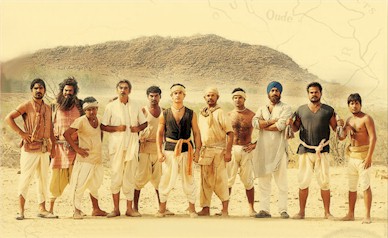
Lagaan is probably the film that has had the widest distribution in the United States. It, like many such epic films, is 224 minutes long. You do not have to do the math for yourself: that is 3 hours and 44 minutes. And the story centers around a cricket match between oppressed Indian subjects and their British colonial oppressors. Yes, cricket, the rules of which I truly do not understand. But I was captivated for every minute.
My favorite feature of this genre is that there is always an opportunity for a full cast musical number, usually with amazing costume changes and beautiful dancing. In Lagaan there were recreations of scenes from the life of Krishna, complete with dancing milkmaidens. And the music is fabulous.
This summer I made a friend who was as wild for this music as I am. We were at a summer camp for adults (in Rome!), and I will never forget this man doing the complete steps for one of Bhuvan's musical numbers--he had even tied a bandana around his head--in the hallway of our little dormitory.
Sometime I could show you some of the steps, which I learned, despite my friend's sincere belief that I was hopeless.

You should also see Hum Aapke Hain Koun. It's a real genre bender: it starts out as a simple story about families and love and weddings and happiness and then about 2/3 of the way through it takes an amazing melodramatic turn, and the shot angles, lighting, and EVERYTHING shifts. You have to see it to believe it.
But the musical numbers in this movie are legion. Weddings. Ceremonies preceding weddings. Naming ceremonies. An entire scene devoted to singing the praises of a beautiful woman--and not one in her teens or twenties, but in her fifties.
It made me feel that all parties should involve parts where people sing about each other's glorious aspects.
I am building my collection of the music too slowly. After much internet searching, I found a used copy of the Lagaan soundtrack, which is no longer available new. I can also recommend The Rough Guide to Bollywood, which traces quite a vast historical span of movie music, and gives you a sense of flavors.

I am also getting to know The Rough Guide to Bollywood Legends: Asha Bhosle. She is hypnotizing. When I bought this record, the PP said, "Ah, I hear she has the highest voice in India." He might be right.
So cinetrix, anytime you want to have a film festival, I'm game to see more.
I do not consider myself knowledgeable in this realm, but I feel passionately about the little bits of knowledge that I do have.
I love the music from these flicks--the delightful combination of dancing (you can see it just in listening), eastern instrumentation, western synthesizers, linguistic blending, and absolutely amazing voices.
And the movies themselves? Oh, the same but MORE.
Lagaan is probably the film that has had the widest distribution in the United States. It, like many such epic films, is 224 minutes long. You do not have to do the math for yourself: that is 3 hours and 44 minutes. And the story centers around a cricket match between oppressed Indian subjects and their British colonial oppressors. Yes, cricket, the rules of which I truly do not understand. But I was captivated for every minute.
My favorite feature of this genre is that there is always an opportunity for a full cast musical number, usually with amazing costume changes and beautiful dancing. In Lagaan there were recreations of scenes from the life of Krishna, complete with dancing milkmaidens. And the music is fabulous.
This summer I made a friend who was as wild for this music as I am. We were at a summer camp for adults (in Rome!), and I will never forget this man doing the complete steps for one of Bhuvan's musical numbers--he had even tied a bandana around his head--in the hallway of our little dormitory.
Sometime I could show you some of the steps, which I learned, despite my friend's sincere belief that I was hopeless.
You should also see Hum Aapke Hain Koun. It's a real genre bender: it starts out as a simple story about families and love and weddings and happiness and then about 2/3 of the way through it takes an amazing melodramatic turn, and the shot angles, lighting, and EVERYTHING shifts. You have to see it to believe it.
But the musical numbers in this movie are legion. Weddings. Ceremonies preceding weddings. Naming ceremonies. An entire scene devoted to singing the praises of a beautiful woman--and not one in her teens or twenties, but in her fifties.
It made me feel that all parties should involve parts where people sing about each other's glorious aspects.
I am building my collection of the music too slowly. After much internet searching, I found a used copy of the Lagaan soundtrack, which is no longer available new. I can also recommend The Rough Guide to Bollywood, which traces quite a vast historical span of movie music, and gives you a sense of flavors.
I am also getting to know The Rough Guide to Bollywood Legends: Asha Bhosle. She is hypnotizing. When I bought this record, the PP said, "Ah, I hear she has the highest voice in India." He might be right.
So cinetrix, anytime you want to have a film festival, I'm game to see more.
Subscribe to:
Posts (Atom)
