Wednesday, August 03, 2005

Today began with H.

Those of you who have devoted as much time (and money) as I have to listening to music will know what I mean when I say that digitizing my CD collection has been a ramshackle revisiting of my life, or at least of those years when I have had a CD player.

I see that my eye skips over certain CDs as if they weren't there, and when I am looking through my shelves for something to play, I don't notice Lightnin' Hopkins these days, or even Buddy Guy, even though those have been favorites in the past. And even though albums like k.d.lang's Absolute Torch and Twang used to make it into my player several times a month, and before that it never ever left it, I have not played it in months. Same thing with Dead Can Dance, and several Bob Dylan albums, all 10 bajillion of my Ani DiFranco CDs and also Talking Heads.

Coming to Baaba Maal reminded me of the guy who used to manage the textbook section of the independent bookstore I used to work for while in graduate school, back when it was everything I could do to buy dried beef and bread for sandwiches. It was the beef that was the real splurge, and working for about 2 months of "bookrush," enduring horrible upstairs un-air-conditioned heat and being part of the human chain bringing boxes up the stairs when the day's shipment arrived, and lugging stacks of textbooks to their designated location, and tolerating grouchy students and sometimes faculty--all that comes back with Firin' in Fouta. Marty was the manager, and he had this great lowkey manner that made him the perfect man to endure the stress of the start of school and push a vacuum cleaner around when everyone else had gone home. I still remember the first time he put that Baaba Maal CD in the store's player: it's that feeling when you first hear something that has to become a part of your life in a much more serious way.

And my graduate school roommate owned a copy of Janet, one of those albums that got entirely too carried away with little talking interludes. I'm not just talking about when she says in that sexy little voice, "Like a moth to a flame, burned by the fire," although it is such cliches that give albums like Janey their charm. You don't listen to pop like this for insights, but to hear what you already know said in such a comforting or ass-shaking way. It's fun when Janet's doorbell rings, and then she has to shut the door before she tells you what you already know, and, it turns out, she knows too, that you want her. And even though it may not have been this album that had an interlude that my roommate called "Janet goes online," it might as well have, because that is where I remember the absurd recorded sound of the modem.

Or there is Madonna's I'm Breathless, which became the prime listening material of an entire group of my college friends for a summer, even though every one of us was deeply embarassed to admit it. Madonna? Not cool at that time, but we were completely smitten with the vaguely swingtime sound of the mood she was trying to create, or even occupy. "But 'More' and 'Sooner or Later' were written by Stephen Sondheim," I would proclaim, trying to justify this smittitude. "But what about 'I'm Going Bananas'?" Richard would ask. "Just skip that one," Mike concluded, and we did, and vaguely howled if we didn't catch the CD in time when that song started, and it played more than a second or two.

And speaking of strange purchases, Information Society's Hack. I bought it exclusively for one song that happened to sound good in one particular car stereo on one particular day. The car stereo belonged to Patrick, who lived down the street from me and who I had grown up with. We spent many an afternoon blowing up plastic army men, or watching cars go around and around a magnetic racetrack, or playing with Star Wars people, or playing that dumb hockey game that does not really involve any skill but may also have been magnetic and all you did was watch your team shuffle around the board and maybe make a goal. And I am not sure how many times we listened to "Flash Gordon" on 45 instead of 33, laughing our asses off at the part where Freddy Mercury sang (fast), "He saved every one of us, he saved every man every woman every child, every body--Flash." You may not know how funny that is on 45. Anyway, Patrick took me boogie-boarding at Virginia Beach, which was a blast, and how much do I wish I had lived a teeny bit closer to the beach so I could bodysurf all the live-long day? And he had some kind of fancy little fast car with a great stereo, and he liked Information Society, and nothing could have sounded better than "Hack" on that particular day in that particular sunshine, and during that particular fantasy that I was a surfer girl. So now I own the entire CD.

Sometime in there, during the poor student years, I got too invested in used CD stores, and being able to sell things back and buy new things for cheap. Sure, it meant that I got rid of some real shlock that probably would not even have nostalgia value. But I wonder what else is gone from my collection, and my memory.

Tuesday, August 02, 2005

Can I get a witness?

I am sure you have long been waiting for more furious reflections on the results of my site meter.

I thought I had the winner when I found that someone had been led to my blog by searching for "swim phlegm." The good news is that the posting on that topic has been so heavily of late that my dear blog no longer appears among the top ten Yahoo hits for swim phlegm. Swim phlegm, swim phlegm, swim phlegm. There. That ought to bring it back up to the top.

And before we move on, don't forget to take This Fun Lungs Quiz!

But "swim phlegm" (can I say it again?) was not the real winner. Behold the real winner.

Sure, sure, sure I can see from that page why my blog came up based on the search, "What is Allen Iverson's cellphone number?" But can someone help me understand what chumpola would believe that that information would be readily available on the internet, a mere Ask Jeeves away?

Bring on the E's

I hope that my two readers (readers? are you still there?) will forgive the recent silence. You see, I have recently upgraded my computer to one with oodlewhops of hard drive space, and I am deep in the process of ripping my entire CD collection. I started out kind of scattershot, uncertain of whether I could fit much on my new machine. O, New Machine, forgive me for my lack of faith! Now I am proceeding alphabetically. We are, as I type, finishing the D's.

All to say, the recent silence may not end immediately.

But in the meantime, I point you to The Gurgling Cod's challenge to food-inclined people of America: an appropriate response to The Guardian's list of top 50 things every foodie should do. I will be the first to confess, apropos the list, that I have ever only done one of them, and I concur with the Cod's general doubts. Which one, you're asking? Well, given that I was following in the footsteps of everyone's favorite American fascist poet, here is a clue:

True, it was Venice,
And at Florian’s and under the north arcade
I have seen other faces, and had my rolls for breakfast, for that matter;
So, for what it’s worth, I have the background.

And will someone please offer an alternative to "foodie" so the Cod will settle his scales?

Wednesday, July 27, 2005

Funky bass funky bass.

Check out freeman's post about Les Claypool's Frog Brigade and then his review of the concert by Les Claypool and his Fancy Band in Royal Oak, Michigan a few days ago. freeman has been generous enough to provide samples of Les Claypool's music, which do rock, and have a listen particularly to the bits from that recent concert.

You do not want to miss this, people, so be warned: the downloads are only good for 7 days or 25 downloads, whichever comes first. Dawdlers are not winners.

Sunday, July 24, 2005

Scooped again.

I bet you didn't know that Jerry Shriver of USA Today is a regular reader of this blog. Goodness knows I was surprised. But how else to explain this article in Friday's paper?

Stately Turin is putting its Games face on
By Jerry Shriver, USA TODAY

TURIN, Italy — Seven months before it enters the world spotlight as host for the XXth Olympic Winter Games, this once-regal city on the banks of the Po River is going through an unfortunate but necessary ugh! phase that temporarily masks some of its baroque beauty.

He goes on to say:
The beautiful Piazza San Carlo, bordered by magnificent arcaded streets, has been torn up to install an underground parking garage.

Scaffolding and tarps cling to some of the stately baroque buildings in the central Piazza Castello area, where many of the medals will be awarded.

Well, dear reader, you read it here first.

He does, however, include a lovely collection of photos along with his article. Go here to see parts of Turin not currently covered with scaffolding. And he points out a number of indoor attractions, things you can still see even with the mass beautification under way. I can personally echo his recommendation of the Museo Egizio, with its amazing collection of Egyptian artifacts and an interesting story to tell about Italian archaeological expeditions in Egypt during the early twentieth century. And I would add the Galleria Civica d'Arte Moderna e Contemporanea, or GAM. (Speaking of creative acronyms....) They have one of the more impressive collections of 19th and 20th century Italian art, centering as you might guess on artists from Torino and environs, but with excellent examples of the rapidly evolving range of styles during that period, and artists like Casorati, Sironi, Balla, and Modigliani. Don't miss it, and then go get yourself some agnolotti. They rock.

Thursday, July 21, 2005

Posting will be light.

Guess what finally arrived from the UK in my mailbox today?

Wednesday, July 20, 2005

Deliberation.


OK, I am ready to take the plunge. I think.

I have decided to train for Nationals. I already have one qualifying time (assuming that this year's time standards don't get too much stiffer) and I hope that during this year's season I can pick up another one.

Is this crazy? Let's see.

ARGUMENTS IN FAVOR:
1. I have one cut already, dammit. It would be a shame to waste it.
2. The Masters Short Course Nationals take place beginning 2 days after my spring grades are due. Is this a sign? It might be.
3. I have a base layer already, from this past year's work, that would mean that I would not need to step up the swimming quantity so much as train with a little more focus. And because my two events would be 100 BR and 200 BR, there is room for focus there.
4. I have the training infrastructure in place, in the form of a team and a good coach who is game to help me pursue this goal--plus the available practice times actually work with the rest of my life.
5. I have had regular and serious training as a part of my life in years past, when I was trying to be a triathlete, before my calf pointed out that I am not a runner.
6. This kind of goal can be very motivating on those days when I do not feel like going to practice.
7. I don't have to train backstroke! This is good for everyone, because no one should have to see that.

ARGUMENTS AGAINST:
1. The sabbatical is over, Sister, and you would do well to keep in mind that you will have significantly less energy to devote to sports during this academic year.
2. It will require care to maintain not only the training schedule but also some semblance of a healthy diet.
3. Might need to cut back on the drinking. :o
4. The new time standards will be available in September, it seems, and I do not even know yet whether my 200 breaststroke time from last year will be fast enough for this year's cut.
5. Do I want the pressure of this goal in my life?

Tuesday, July 19, 2005

Advice to travelers

Welcome me home. Yes, after a fine honeymoon, with no groom, and after a couple of rough days of travel, I am home, home again. Without plans for big trips for a while. Whew.

But before I leave topics Italian completely, let me offer you one piece of advice.

If you want to visit an Olympic host city, do so after the games, not before.

Torino, capital of the Italian Piemonte region, will host the 20th Olympic Winter Games in February 2006. The city is psyched: there are special Olympic Stores all over the place, not to mention the ubiquitous rings and stylized torch in front of the Porta Nuova train station.

But unless you are more interested in seeing construction sites than touristic sites, you might rather not be part of the lead-up frenzy.

Touristic. That is one of those words we don't really use in English. In fact, per my dictionary, the adjectival form of "tourist" is "tourist." (It can be an adverb too--how efficient.) But because Italians can talk about "siti touristici," then their pamphlet translations use this new specially adjectivized form of the word. So presto, now it is an English word, and I kind of like it.

If you have traveled in Europe recently, then you have seen the new way of handling sites under restoration. Used to be there would just be plain old scaffolding over the thing being fixed. But is a Tyvec-wrapped scaffold any substitute for the actual facade of the cathedral in Orvieto? And if you have traveled thousands of miles to see the thing, is the greater cultural enrichment of Europe really what you are thinking of as you stand there in the square, your camera lowered?

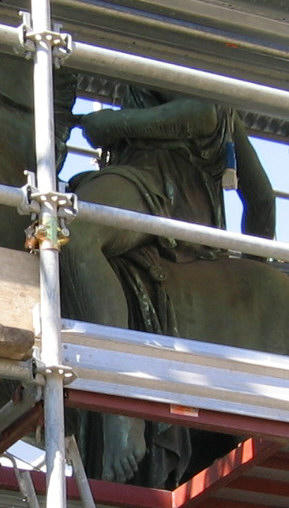
So now those scaffolds are hidden in boxes, covered with some kind of sign material, often including a photo of the thing that is in restauro. For instance, this beautiful bridge across the Po has bronze statues at its four corners, allegories of Piety, Valor, Art and Industry. Now there is an allegory of Restoration--complete with its generous donors, each of whom gets space on the box for a logo. See? This way you get to see the statue even while it is being worked on--see it in that Age of Mechanical Reproduction kind of way. What might Walter B. say has happened to the statue's aura?

I am all in favor of new underground parking decks to replace the use of Turin's magnificent baroque piazzas as parking lots, but trust me that having an espresso in one of the city's famous cafes is not the same with a different view.

Sunday, July 03, 2005

La festa di Nostra Signora di Montallegro

Last night I saw the coolest fireworks show. No, it was not an early 4th of July hoohah, although it turns out that my present home had its own fireworks display last night, much to my cats' dismay.

No, this was a fireworks show celebrating deliverance from the plague, a part of a festival held in Rapallo every year on 1, 2, 3 July, giving thanks to the Madonna of Montallegro.

The evening started off with three boats in the Tigullian harbor sending off little lights into the sea. Each boat must have released hundreds of the thing, over the course of a couple of hours, and watching their small lights float away was so serene. Very different from what would come next.

Namely, the firings of mortaletti, an ancient type of firework traditional to Rapallo. Each of the sestieri, or quarters of Rapallo puts together its own display, trying to outdo the others.

I happened to be watching from just above the fifteenth-century Castello right on the harbor, and beside it was the staging area for the display given by the Sestiere Borzoli, whose pirotechnicians all wore red shirts, and their area is marked off with red pendants. They have even painted a very cool shield on the pavement there by the beach.

Sometimes they would fire off one or two mortaletti, but a few of their firings involved multiples, strung together with paths of gunpowder. They would fire off a round, and then all around the harbor, the other sestieri would fire theirs. Ssome of them were too far away for me to see anything, but for some I could see puffs of smoke after the BOUM or else a few sparks and then the BOUM. But for the sestiere Borzoli, I had to plug my ears.

Their grand finale was impressive, even though I could see in advance what they had planned: a path of single mortaletti, then a small cluster, then a few more, then a double path leading up to an enormous conglomeration of the things. From the time when the guy with the long lighting wand walked over, to the end of the sequence, was fairly short, but full of fire and noise.

After all the mortaletti was a visual show over the harbor, and although my view was not perfect, I could see pretty well, and after all, I was in my room, not standing in an enormous crowd. Did I mention that all this was happening at 11:30 p.m.? For a lame-o like me, standing in the crowd would have been a strain, but from my very own room? As long as I hid behind the door to my balcony, I could even stand outside a little bit, even though the polizia had been yelling for people to watch from indoors. There must have been quite a danger for Italian police to be monitoring things!

And the fireworks were magnificent. It was strange, as an American, to see them for a religious festival, as they always seem to have Stars and Stripes Forever in the background, instead of Ave Maria. And even the choice of the O Fortuna opening from Carl Orffàs Carmina Burana did not seem strange in a festival dating back hundreds of years and celebrating the delivery from the plague.

Look here for more about the festa, the fireworks, and the sestieri. If you donàt read Italian, follow the link to the GALLERY for a bunch of great photos.

Saturday, July 02, 2005

Italy = not a picnic

OK, Horvus A. Callithumper has shamed me into a quick post. I had thought maybe I would take a little break from the web, but no no no I could not resist checking in, and there are comments from mtnRoughneck and even Anonymous, so OK.

If this post looks strange, it is because I am typing while wearing sunglasses. Oh yes, and the funny diacriticals in unexpected places on Italian keyboards.

I can offer anyone planning to travel a few pieces of advice.

1. If your several-years-old glasses break at some point while you are in the comfort of your own home, and it seems easy enough to fix them with superglue, go ahead and fix them, but then really you should get yourself some new frames. You do not want the little arm to break off afresh while you are in a foreign land, particularly when you have recently arrived and you do not have anything else to wear or any tools or any recent sleep.

2. If possible, when traveling overseas, do not check your bag, especially if you are planning to travel lightly anyway. Sure, sure, I hear you about not wanting to lug the thing around in airports, and about worrying whether there will be room for it in the overhead bin, and about how you want to bring you handy Swiss Army knife along. Get rid of those thoughts immediately, for they only lead you down the path of pain and suffering. After all, many airlines see getting your checked bag on YOUR FLIGHT as an unnecessary bonus, especially when they are about to go bankrupt.

3. Believe what it says on tubes of superglue (or colla rapida, as they say here in Italia) about the glue working fast and sticking to skin. Especially believe it when you are considering, given your lack of any pins or similar items, whether to try to bite off the little tiny end piece on a tube of superglue. Especially since biting off that little end piece exposes more glue than a little pinprick would.

4. On a happier note, remember that there is little that a shower and a good night's sleep won't make tolerable. Even better if you can combine that with clean teeth, newly acquired deodorant, and a clean shirt and undies.

5. Even happier, sometime before you die, take the train from Roma to Rapallo. Somewhere around Pisa you start seeing beautiful mountains on the inland side of the route, and a little north of there the route veers west so that you are barely not in the Mediterranean. You go in and out of tunnels, since the coastline is mountainous, and each time you come out you get a stunning sight off to your left, that clear blue of the Med. Gorgeous. And the little towns along your right are all painted in those gorgeous oranges and pinks that look horrid anywhere but this kind of light.

6. And if you ever stay in the Hotel Italia e Lido in Rapallo, spring for the camera vista mare, with the sea view. I figured it might just be a tiny glimpse out of one corner of the window if you are the right height and the stars are perfectly aligned, but in fact it is splendid, with the Castello, the beach, and the sweeping coastline all right outside your window. I wonder if I'll be able to see the lights tomorrow night, when they are all set afloat in celebration of the festa of Nostra Signora di Montallegro, and maybe the fireworks, too. I hope they are visible through my prescription sunglasses.

p.s. to Tim: here in Rapallo, the weather is perfect. Heh.

Thursday, June 30, 2005

Buongiorno, Roma.

Have yourselves a nice couple of weeks. I am off to one of my favorite places--Italia. But I should honestly say that I will spend but 2 days in my favorite city, and then it is off to places unknown, to me anyway. To Rapallo for a few days, and then on to Torino. In the first place I am Pound-hunting, and in the latter hoping to look at some of Vivaldi's own collection of manuscripts.

So wish me well. One thing is certain: I will eat well. OK, really two things, if you count the drinking separately. Ah, the land of good, cheap wine!

Friday, June 24, 2005

25 June 2005

This weekend two of my friends are getting married.

I wrote that sentence only because I wish it were true, and because it should be true. The more accurate sentence, but really not the truer sentence, should say, This weekend two of my friends are exchanging union vows. Of course they, like any other pair of women (or men) who have decided that they want to commit themselves to one another, cannot get married.

You will notice that I am not at their wedding, and the result is this intense dilemma. I am not at their wedding because last weekend I got married, and this weekend I am exhausted, and I really need to spend some time with the PP without everybody looking. This weekend, no one takes a picture when I hug him. This weekend I am not getting my hair done or putting on panty hose, and he does not have to wear a tie. I will probably spend all of this weekend with my feet in and out of only one pair of extraordinarily comfortable shoes. No parties--I am putting my foot down. This weekend we are drinking beer and watching movies and not answering the phone and maybe eating dinner out somewhere low-key where we do not need to dress up.

Who am I kidding? You don't have to dress up to eat anywhere here!

But this means I am not at their wedding, and instead I am thinking about them desperately. I am thinking that I hope that whatever family members got their reply cards all tangled up in their so-called morals, and so could not even send a polite "no" but had to raise a stink about not approving, are not missed. I am thinking about their chocolate fountain, and hoping that whoever they got to make it when the first guy--who originally said it was not a problem to make a chocolate fountain for a same-sex couple but then later stopped returning their calls and finally said he couldn't do it--backed out, I'm hoping that that new person makes them a hell of a chocolate fountain, and that my two beautiful friends can then see past that first guy and his hang-ups and enjoy that chocolate fountain for all they are worth.

I am thinking about the discussion we had recently about honeymoons, about where in the world would you go if you could go anywhere in the world, and how one of them had decided exactly where, and the other looked at me in disbelief at the idea that the whole world was out there, available, but then not really because this was just an abstract question with no footing in reality. But once I rephrased it as "where would you go if you had two weeks and $3000 and enough frequent flyer miles to cover your tickets," she got on it right away and we all had a great time thinking about possibilities--and laughing at ourselves.

I am thinking about their mothers, for whom this wedding has become a sort of realization of all the ways that being queer in America sucks--and of how people who don't know you decide they can go ahead and judge you because they have decided that that is what their Bible says to do. (Not that those people tend to be the best readers--I know this because they have been in my classes, and I have worked desperately with them, but it has not helped.)

And I am thinking about how they managed to be stronger women than I am, and bring their anxious it-is-only-a-week-until-our-wedding selves to my wedding, and to be happy for me, and even dance some and laugh a lot. I am thinking that I wish I had the endless strength that could have gotten my ass on a plane to Virginia today, so I could be there to say to them that I think that what they are doing is heroic and honest, not to mention that they are adorable as can be and that they inspire strength in me, even when I am not able to carry it forward.

Because I do not have enough strength to get on that plane, I am here having a quiet weekend with the PP. I wish I could say that I do not feel bad about that, but a part of me does, even as a part of me would not have this weekend any other way. But that is the way it goes, isn't it? That we rarely have untempered joy or grief?

But here's to you, my two wedding friends. I hope this weekend can be a real moment of joy, and that at the end of it you feel exhausted by the love of your family and friends.

Seasons 5-770


I would be willing to bet pretty much anything that you do not own as many Vivaldi CDs as I do, and that positions me well to recommend a few for you that may not have come across your desk. Well, that and the fact that I am still too brain-dead to complete the real work I should be doing, and the PP is off at work, trying desperately to pay off his deficit of paid vacation.

So all further self-pity at my sad and lonely state must be pushed aside.

Vivaldi!

Please, for a little while, stop listening to The Four Seasons. Yes, there is some truly lovely stuff in there, but the man wrote something like 770 works, for goodness sake!

OK, here is a small bone for Quattro Stag fans. You might be wonder why those pieces get to have all the fun. Let’s go back to the first part of this century, when little of Vivaldi’s work was known, and Grove still said “Vivaldi in fact mistook the facility of an expert performer (and as such he had few rivals among contemporaries) for the creative faculty, which he possessed but in limited degree.” At that point Alceo Toni, a musician and journalist, made reductions of the four concerti for four-hand piano. That meant that in bourgeois households all over Italy, the quartet of concerti that would make Vivaldi famous could be played and played again.

If you are interested in hearing how the Four Seasons sounded in some of their earliest twentieth-century performances—and certainly the earliest recordings—listen to the Orchestra dell’Accademia di Santa Cecilia from 1942, conducted by Bernardino Molinari, available on a very cheap CD from Aura. Set it next to your favorite contemporary recording of the piece, and behold the power of big string orchestras! Sixteen first violins! Big organ sound for the basso continuo! To our ears, accustomed as we are to the later-twentieth-century taste for pared down baroque, this is a trip back in time, a chance to remember another sensibility.

The finest performer of Vivaldi’s work for violin that I have heard is Andrew Manze, whose recording of the Opus 6 concertos and the “Cuckoo” Concerto (RV 335) rocks (with the Academy of Ancient Music directed by Christopher Hogwood, on Decca). There is nothing mechanical in his playing of the baroque violin: in his hands, the solo line is sexy and even jazzy.

But there are so many other wonderful concerti by Vivaldi, each with its own flavor and an enormous range of orchestral composition. What pleasure there is in moving from the traditional solo violin to the Concerto funebre (RV 579) for oboe, chalumeau (the jury is still out on exactly what that is), violin, three violas all’inglese and of course strings. Or a concerto for two recorders, two oboes, bassoon, two violins and the obligatory strings. I am personally fond of the bassoon concerti, and there is a great disc of six of them performed by I Musici under the direction of Klaus Thunemann on Philips, but that may be out of print, and there are lots others out there.

Bach knew something of the range of Vivaldi’s work, as he transcribed a number of his concerti for harpsichord and organ. I would give my left eye (if I could later get it back) to hear his concerto for four harpsichords and orchestra (BWV 1065), a rendition of Vivaldi’s concerto for four violins (RV 580). I understand there is a recording of it on Naxos, and I am still trying to track that down, but I would rather see it performed live, so I could see what all those keyboardists are doing. You can find a couple of the harpsichord transcriptions on Richard Egarr’s J. S. Bach: Per cembalo solo… (harmonia mundi).

The tradition of transcription continues today, and there are far worse introductions to the range of Vivaldi’s music that Yo-Yo Ma’s recent Vivaldi’s Cello, performed with the Amsterdam Baroque Orchestra directed by Ton Koopman. The disc includes pieces written for cello, but also transcriptions of familiar and unfamiliar works into cello pieces. There is the slow movement from the “Winter” concerto of the Four Seasons, and a concerto for viola d’amore (RV 540), but then also we find pieces from such big choral works as La fida ninfa and Juditha triumphans, not to mention the famous setting of the Gloria (RV 589). This whole collection is fabulous.

Do not miss the choral works, though, in their choral state. You might already know the RV 589 Gloria, but Vivaldi has another Gloria (RV 588), as well as a Magnificat (RV 611), Stabat Mater (RV 621), and a Beatus Vir (RV 597)—all of which could be yours in a (pardon me) glorious 2-disc performance on Philips by the John Alldis Choir, English Chamber Orchestra, Royal Concertgebouw Chamber Orchestra, conducted by Vittorio Negri with numerous soloists. Still less known is Vivaldi’s bel canto work, the Serenata a tre, the tale of pastoral love among nymphs and a shepherd. It is available in a recording by René Clemencic and the Clemencic Consort on harmonia mundi.

And Naïve has undertaken a fine collection of recordings of all the Vivaldi works held in the Biblioteca Nazionale Universitaria di Torino. When these over 300 works were discovered and catalogue in the 1920s and 1930s, and then gradually published over the course of the twentieth century, Vivaldi’s reputation could not but be revived. What an amazing thing to discover, that this composer who had long been dismissed as a mere virtuoso performer had in fact composed an enormous range of music for exciting combinations of instruments as well as for singers. Vivaldi’s Orlando Furioso has been performed before, but have a listen to the new Naïve recording (performed by Les Eléments and the Ensemble Matheus under the direction of Jean-Christophe Spinosi). I can personally recommend the Naïve recording of Vivaldi’s Motets, featuring soloists Anke Herrmann and Laura Polverelli performing with the Academia Montis Regalis under the direction of Alessandro de Marchi.

And lest you think this work of recovery is complete, have a listen to the newly rediscovered and reconstructed Bajazet: Fabio Biondi did the hard work of recovering arias missing from the score, and his recording on Virgin Classics makes that work available to us all.

So the next time you think about Vivaldi, do not roll your eyes at how kitschified his work has become. Steer past the “baroque favorites” CDs and venture into this amazing trove of compositions.

Wednesday, June 22, 2005

Put your body next to mine and dream on.

If all you want is the short version, then here it is: I am now wed, and I have the funky piece of metal on my hand to prove it.

And if you have no interest in the incredibly long and drawn out version, read no further.

As I was drowning in the endless anxiety that I understand is normal for weddings, a friend wrote:

Many congratulations on your upcoming nuptials, and all the best to you both. And I'll keep my fingers crossed for rain. As they say in France, 'Mariage pluvieux, mariage heureux'. However, the weather during our civil union in Vermont was dazzlingly sunny--but then it was early July--and yet I think we've done tolerably well.

Lucky me, that I have such a collection of sensible friends, who know how to give the advice that lessens anxiety. Believe me, friends, I have taken every bit of it.

(Special thanks to my seminarian friend: I used her advice again and again, sometimes in jest, sometimes under my breath.)

It did not, as it happened, rain, so I have to be hopeful that my union will fare as well as my French-quoting friend's. In fact, even the oppressive humid heat that typifies summertime in my hometown broke just in time for all the festivities.

(Which is more than I can say for the mosquitos and no-see-ums. Note to self: sack-like voluminous dresses at garden parties allow the little blood-suckers all the way up into places that do not need mosquito bites.)

And festivities there were: we had a smallish (by which I mean about 15 instead of about 95) dinner on Thursday, then an Italian-themed rehearsal picnic on Friday (featuring a gondola made from a kayak with rudder add-ons, a beer cooler in its seat, and none other gondolier than a scarecrow featuring the PP's enlarged photograph face, with a most fabulous curly moustache painted on), then the wedding itself + reception, then a party at my parents' house (more fabulous food), then a brunch on Sunday.

Whew!

But despite what everyone says, I remember a lot from the Big Day.

I was thrilled and surprised that my 80-something year-old great uncle and his wife could be there. He is the brother of my mother's natural father, who was killed in World War II, and when his reply card arrived, there were immediate celebratory phone calls throughout the family network. My great-uncle and great-aunt charmed everyone at the wedding with their fabulous dancing and good spirits, not to mention the fact they had driven all the way from Buffalo for the occasion.

We had a terrific collection of family and friends reading in the ceremony. Two of our friends from here officiated (although no church or state has vested authority in them), the PP's sister read from Song of Songs, my father read three poems he had written (which were by turns overwhelmingly touching and then hilarious), and a dear friend from here (who vied with my great-aunt and great-uncle for Most Likely to Charm the Wedding Guests Off Their Feet) read a tribute to our parents. The best part was that although we had worked with her on that tribute, and written our own vows, we had not read or heard my father's poems or our officiants' words, so the ceremony was mostly new material for us. What a thrill to listen to wise people say wise and emotional and hilarious things in your honor!

We had chosen two officiants because we wanted a balanced statement of a lasting relationship, and the couple who spoke have been good friends of ours ever since we have been together. I loved it that they each wrote parts of their words, and then combined them, because both their voices--so different from one another--were there, as were words from Plato, Margaret Atwood, and e. e. cummings.

And in my father's poems we could hear pieces of our quotidian existence turned and returned into little finely crafted pots. Recognizing many of the stories around which the poems were built, I got to see those moments in a new way, or through new eyes, or with more insight, that made them feel important, revelatory. The first poem was called "The Wedding," and it imagined the wedding itself as an unruly child, willful and ready to take over your life, even as you wanted it there. The second, "The Poem from One to Together," began with the word "one," and imagined how two very different ones might get along, ending, as you have probably by now guessed, with the word "together." Rereading that description, it sounds hokey, which it definitely was not. The last, "Your Wedding," took my almost obsessive fascination with penguins and turned the entire "congregation" into a waddling, wobbling conglomeration of the funny birds.

We had enjoyed writing our vows together, too. We knew that we wanted original vows, but I was afraid that, being the emotional sap that I am, I would not be able to deliver mine audibly. Plus, we were a little uncomfortable at the idea of vowing different things to each other. So we wrote them together, trying to hone an entire relationship's worth of feelings into about 9 vows. (Granted, some had multiple parts.) Then our officiants read them aloud and we repeated them in unison. We alternated between more abstract and more concrete visions of our relationship. A number of folks complimented us afterwards, although the vote is still out over whether "I vow either to cook or clean up but rarely both" or "I vow never to comment on the condition of your study" was the most resonant.

Given the high praise, the PP, of course, is working on how we might sell them.

Another highlight, though, was our first dance. We had wrestled with that one, because all the songs we really love got tricky for that moment, given the complications that real life throws into one's own relationship and that pop music has the privilege to ignore. We finally settled on "Handle With Care" by the Traveling Wilburys, and decided that given the perky nature of the tune and our vision of the wedding as being a communal experience, we would ask everyone to dance with us. We arranged for a number of "audience plants," so that people would believe the DJ when he asked them to get up and dance. And to our amazement, they did! The little dance floor was completely packed with our family and dearest friends dancing and laughing and remembering this old hit, and realizing that they too had been beat up and battered around, that they've been robbed and ridiculed, that they still have some love to give, and that they still needed somebody to lean on.

I have decided that getting married when you're older, when the world has hit you in the face a few times, is fun. Neither of us believed that this was or would be the most important day of our lives. Neither of us believed that every detail had to be perfect, as if it were some kind of storybook fantasy. Neither of us freaked out when the DJ was caught in tunnel traffic and so arrived about 2 hours late. I, for one, did not worry--and I don't think the PP did either--that my body was not what I would have hoped for in my wedding pictures, because is it ever?

And neither of us ran away to Las Vegas, because ultimately, it was just a big party. OK, so really it was five big parties in a row, and maybe we are a little too old for that. But I love the memories of our family and friends' words in the ceremony, of the audience giggling at some of our vows, of everyone dancing around and laughing. Because if a wedding is not about dancing around and laughing, what is it?

Monday, June 13, 2005

Settle down, Beavis.


A friend told me that the only really essential parts of a wedding are the happy couple and the officiant. Looks like we have those covered.

And being me, I have also scanned through my 5 lists about 6,000 times a piece. I have a AFTER FRANCE list (check), a BEFORE WE GO list (check), a TO TAKE ALONG list (all check, save toothbrush, etc.), a WEDDING WEEK LIST and a DAY OF THE WEDDING list. Those last two, of course, are NOT check, and maybe that is why I am not sleeping.

But tomorrow we get in the car and drive to the old home town. I have all the outfits picked out (and Mom, I even packed earrings!), we have CDs ready for the cartrip, we have spare towels for the three barf-ready cats traveling with us, and all the gifts for people who are doing nice things for us. Plus it looks like we don't have to drive through Arlene.

It is interesting to come across my cousin's blog and read about how she is about to set off for her vacation, which includes the wedding.

And last night my family, who were making bombolieri for the reception (little Jordan almonds wrapped in netting and tied with a ribbon). As is the tradition, they passed the phone around the table and I got to say hello to everyone. The person who is coordinating the rehearsal dinner, and also the bombolieri-making, was a little concerned, because about two-thirds of the way through the process they had to switch from 4 to 3 almonds per packet, and she was hoping that no fights would erupt at the reception because of this inequity.

I passed along a word of advice that a friend gave me yesterday: "if anyone gives you any shit in this next week tell them your presbyterian seminary friend said they can sit on it."

With that in mind, it is going to be a good week. If only I could use those words every week.

Talk to you again in a week or so.

Thursday, June 09, 2005

Only the finest heteronormativity for me, thanks.

I am thinking a lot these days about categories--boxes, compartments, the places we put ourselves because they feel safer. The ways we show that we are different from people around us. The ways we affirm what matters to us.

It turns out I am not the only one. I am no longer surprised by comments that suggest that those who disagree need not apply--or show up, or read even. Here are a couple of examples, both from blogs I like, but which seem to have pretty different readerships. In one part of the blogosphere, a writer responded to the discussion generated by a previous post by saying, “I don’t disagree on substance with any of the respondents. We’re all in the left wing of the Democratic Party.” Elsewhere, a respondent reassured a writer: “Perhaps ‘furious’ would be better suited to this blog, rather than one that is obviously far too phallocentric as yours, bk.” Underlying both comments, and many others in cyberspace is the assumption that people read only those sites that they already agree with. And such passes for free and grass-roots discussion of ideas.

This is no surprise. Lots of people--all smarter and more on the ball than I--have written astute things about how the web supports fractured communities, places we can all go and feel safe and fuzzy knowing that the other people are just like us. Just. And how nice it is to express ourselves to those we know will agree! It so beats discussion with people we might actually have to convince--whose motivations and points of view we have actually have to understand or even identify with in order to convince them.

I had a conversation with a friend who works for the GOP. He pointed out that left rhetoric often alienates conservatives. He noted too much profanity. “How would that play in Peoria?” he asked me, also referencing his own ardently Christian grandmother.

He is right. I was also right, I might add (with puffed up chest), when I noted that there is plenty of conservative rhetoric that similarly alienates. He gave me that. We had a warm fuzzy moment where we knew that although we could not agree about the results of the election, we both know that America is going to hell in a hambiscuit, as a friend used to say.

So that is one kind of box--the kind we put ourselves in and are content to occupy. From time to time we venture to other people’s boxes, but mostly when they look really a lot like ours. There are exceptions, of course, and I applaud them. To name one example, freeman routinely imagines a dialogue with the left, and he even has selected a sidebar of writings that he thinks should especially appeal to those of the leftist persuasion. I only wish we were all more willing to venture into unknown territory.

Then there are the boxes made by those who see a black and white world. I have come across two instances recently of discussions that specifically take on that issue of binaries.

Recently on ALAS (a blog), a self-described bisexual man wrote about biphobia in the BGLT world, and his piece has (so far) elicited 104 comments. The argument rages--what does it mean to occupy a position that is neither gay nor straight, attracted to both but a part of neither? Based on the comments, it seems that a good bit of the discomfort with bisexuals in the gay world is pretty much like that in the straight world: why don’t they just figure out where they belong and go there?

Furious, wouldn’t you be more comfortable reading ideas of people like yourself than of liberty-loving people like ourselves?

And in another part of the blog world, Ian Williams suggested that some of the discomfort with gray shades comes from our switch from analog to digital culture:

In the 70s, when I came into consciousness - in the 80s, when I came of age - and in the ’90s when I played out my adolescence - we had something called “static.” It was the space between radio stations, the poorly-received television signal, the hum of the record player at the end of an album, and the hiss of a bad phone. This was an Analog culture, where shortcuts could be taken, songs could kinda be heard when driving under bridges, and mix tapes had to made in real time.

Those days are rapidly disappearing, replaced by today’s Digital culture, which is clear, clean and unforgiving. With XM Radio, you either get a signal or you get nothing. Either your iPod works or it doesn’t. Cable TV is on, and there’s no getting the porn channel by placing the dial in-between stations. Your cell phone, even your internet signal is binary: you get service or you DON’T, there is no in-between.

For Ian this was an explanation. I agree with his read, but for me, it is a lamentation. What does it say about us that we have lost our ability to imagine something that our iPod cannot?

I had a conversation yesterday with a lesbian friend of mine. Over lunch, she gave me a gift and a great card in honor of my impending marriage. She asked how I was feeling about it, and I told her honestly that although I am thrilled to imagine a committed future with my Patient Partner, I have real questions about marriage itself. Like others of my friends, she had smiled patiently at me a few months back when I told her I wanted to print lines from Marianne Moore’s “Marriage” on my invitation:

This institution
or perhaps one should say enterprise
out of respect for which
one says one need not change one’s mind
about a thing one has believed in,
requiring public promises
of one’s intention
to fulfil a private obligation:
I wonder what Adam and Eve
think of it by this time,
this fire-gilt steel
alive with goldenness;
how bright it shows--
“of circular traditions and impostures,
committing many spoils,”
requiring all one’s criminal ingenuity
to avoid!

OK, so that might not have made the most enticing invitation, but still!

Although I did not say so to my friend over lunch, because the conversation turned in other directions, I wondered: with this ring, am I (as I profoundly hope) buying an inside line to shape the institution as I see fit? Or am I buying into the dominant paradigm, giving over my position of resisting those boxes? Is it yet another delusion to think that any individual could impact an institution so powerful as this? Should we just have the ceremony’s readings be from Althusser and just be done with it?

I am grateful that the PP shares my concerns, though his reasons are of course his own. I am grateful, PP, for your optimism, and that you do not let me sink into the various Doomsday scenarios to which I am prone. Keep me strong, PP, and keep me honest. Don’t let me get complacent, or settle into the easy dismissal of others that this safe box could allow.

So wish me luck next Saturday. If all goes well, I won't bolt for Las Vegas or New Mexico and then call the police. Or if I do, I will have the good sense to drag the PP with me.

Friday, June 03, 2005

Intelligent Design

I owe all of my readers an apology.

I was not, as I sarcastically claimed, taking a class on intelligent design for the last two weeks. That was supposed to be an oh-so-witty comment on the debate here in the south about removing evolution from science curricula in the public schools. But three of my four readers took my sarcastic claim seriously, which, as any teacher knows, means that the problem was not in the test-takers but in the test question.

So sorry for the lame joke and confusing post.

But I can tell that over the last two weeks I have been doing some thinking about design, intelligent and otherwise. Especially the otherwise, of which I have encountered numerous examples.

Here are my conclusions:

1. Having people waiting in a long line go through a series of stages to, say, oh, check in for a flight, is not a bad idea, but the stages should be designed such that the first checkpoint does not hold up the waiters so long that the checkers at the second checkpoint are waiting around for new waiters to approach their checkpoint.

2. There should be an application process for people who are going to use the machines that dispense tickets at, for instance, a museum. The process should be rigorous, so that when people get to the machine they do not stare at it blankly, then look around helplessly for someone to help them. Questions on the application might include:

* Did you get your money ready while you were waiting in the long-ass line, or are you planning to wait until you are right in front of the machine to fish around in your change purse?

* Are you capable of interpreting the little graphics that show which way to insert your credit card?

* When the sign reads "This machine accepts 1's, 5's, 10's and 20's" does this really mean:

a. The machine accepts 1's, 5's, 10's and 20's only.
or
b. Because I am special, I can expect to pay with a 50.

3. Digital cameras are the downfall of the museum experience. People seem to think that because they do not want actually to look at paintings, taking digital pictures of them is a good idea, so they can prove to all their friends that they saw them, even though really they did not. Digital cameras make this process easier because you need not hold the camera up to your eye, but can simply look at the little screen. Plus, since you do not have to buy film, why not take a picture of every painting you see? Never mind that photos of paintings from museums tend to look crappy, and even worse when you shoot with a flash and the picture is covered with glass. Plus, hasn't anyone told these people that repeated flashbursts dim the pigments in paintings?

4. I understand that it is necessary to have your bags before you clear customs, but in this modern world filled with brilliant thinkers, can we not come up with something more efficient that waiting to get off a plane, waiting to go through Immigration, waiting to get your bags, waiting to clear customs, waiting to re-check your bags, waiting for the dumb train to take you to the main terminal, waiting for your bags again?

5. While we're talking about clearing American customs, would it be so difficult to including some English signage to indicate which line you need to be in? I appreciate the goodwill that comes from telling speakers of Spanish, French, and Japanese which line they need to be in if they are bringing clams into the US of A, but would a little English break the Homeland Security budget?

OK, I am done complaining now, and, yes, I had a marvelous time in France, and, yes, I have the imperial waistline to prove it.

Tuesday, May 17, 2005

Amuse yourselves.

Dear Friends,

I am afraid we are entering yet another hiatus on this blog. Contrary to the hopes of certain members of the blogging world, I am not slinking away to reconsider my position on the explotation of women, men, animals, or anyone else. No, I am off for a two-week summer school session on Intelligent Design. I have always been sorry that I did not take more science in high school and college, so I am going to rectify that now.

I was going to say, "While I'm gone, read Michael Bérubé, because his writing always kicks ass." But oh great: he's taking a break, too--AND he got a load more writing done during his semester off than I did. Thanks for making me feel like a slacker, Michael, but really you needn't have any concerns about your prose. It is mighty fine.

But it looks like he'll have a couple guest contributors, so read them for me while I am away, and let me know what you think. I'll have a lot to catch up on when I return.

Monday, May 16, 2005

The leads are weak.

My favorite moments used to be when the "NOW HIRING CLOSERS" sign would appear at the local Burger King. It was my big moment to have one of those elitist private laughs at the business world, when it had inadvertently stepped into a literary critique of itself. I would wonder, at those moments, whether the handy instruction manual for Burger King closers might read, "Always be closing." I really, really hope it does.

Now I am also happy that the Patient Partner has taken to referring to our fancy schmancy coffee maker as The Machine. That way, when we have forgotten to set it up the night before, or I have to clean out its many parts, I can simply say, "Fuck the Machine!" To which the PP, except when he is really sleepy, obligingly replies, "Did you say, fuck The Machine? She said, fuck The Machine!"

At which point Jacques Monod is rarely amused, and says, "Put that coffee down. Coffee is for closers."

But friends, these moments just don't stack up anymore.

Not long ago, the PP and I took a sojourn in New York, in part to see the new revival performance of Glengarry, Glen Ross.

I don't know if you are a David Mamet fan, but the production rocks, and not just because of the cast. I will confess that prior to this I had only seen the movie version, of which I am immensely fond. I have made the mistake of suggesting to people who work in sales that they should see it, no really they should, because it is so, so good. They usually come back and give me the look with which I am now familiar. It is a look that says, Why did you make me do that? and also wonders whether I am truly a friend.

I am, but really, it is so, so good.

So imagine my surprise, when the PP, upon returning from NYC, had lunch with some colleagues of his in the sales department at his company. They asked him how his trip was. He said how much he liked the subway and the great Vietnamese restaurants, and how good the play was.

"Oh yeah," one of them replied, setting down his third beer. "Our sales manager used to show clips from that movie during our motivational sessions."

Huh?

Now, granted: I could see how that Alec Baldwin scene, out of context, might--I say MIGHT--have some useful pointers in it. (Nota bene: that scene is not in the original play.) But surely, if the aforementioned sales manager were going to track down that scene, surely he would have HAD to have watched the whole thing?

But without sounding too much like Alanis Morissette, I suppose I could acknowledge that the world is full of such ironies. That it can be the people who claim to be defenders of freedom who smack you down when you stop goosestepping. Or I could note that sometimes people watch things, and they just don't get it.

Sunday, May 15, 2005

Women who rock.

Snaps to Pem, who yesterday completed her first triathlon. I can personally testify to how strong she looked coming in and out of all the transitions as well, of course, as the finish. To those of you who have never watched or raced a triathlon, it is a crazy event, with people coming and going, swimming and biking, biking and running all over the place. The ins and outs of the transition area are great to watch: some racers have devised elaborate systems to get grass off their feet before pulling on socks, some don't bother with socks, some are pulling the top half of their wetsuit off as they race up the hill from the lake, while others shimmy out of the damp thing in the transition area itself. The front racers often come in with those solid race wheels humming, while some race on mountain bikes.

Read Pem's account of her race: it gives a great sense of the experience, and of all the details to think about in a race that involves three sports and quite a bit of time.

Congratulations, Pem. You rock!

Friday, May 13, 2005

Happy Anniversary?

Welcome to May 13.

Can it be a happy anniversary, if it was twenty years ago today that police in Philadelphia dropped from a state police helicopter a satchel of explosives on a house on Osage Avenue?

And killed 11 people, destroyed 60+ homes, and left 250 people homeless?

If mayor W. Wilson Goode was "saddened" by reports of the fire's spread, beyond the bunker that was supposed to be the target?

As Alice Walker wrote from Paris in response to the bombing of the MOVE house, "Every bomb ever made falls on all of us."

It was what has become a classic case: MOVE members disliked the norms of society, chose to live another way, and brought down on themselves the anger and frustration of those around them. They wore their hair in dreadlocks (which other residents of their middle-class neighborhood thought odd and unclean). They espoused a back-to-nature lifestyle (which other residents thought dirty and smelly). They argued against the way children were taught and kept them out of schools (which made them truants). They rescued stray dogs (who barked at night, disturbing their neighbors). They broadcast their arguments over a bullhorn (which drove their neighbors insane). They did not pay utility bills and breached housing codes (which merited arrest warrants and later the bombing of their house).

Do you remember what Police Commissioner Gregore J. Sambor said from his bullhorn on the morning of the bombing?

Attention, MOVE. This is America. You have to abide by the laws of the United States.

Or what one of the neighbors of MOVE said afterwards?

It was well worth it, because they're out. We'll be back and we'll be a community again, without MOVE.

Or do you remember the event at all?

Well, at least some people in Philadelphia are still talking about it, trying to make sense of the events, the media coverage, the memories and their lack. And Democracy Now featured an interview with the only adult survivor of the incident, back on the 15th anniversary. And there is a protest in Philadelphia tomorrow commemorating this anniversary.

If you go back and read some of the newspaper accounts of the event, you will be struck by how they present MOVE. There is no attempt to understand the group’s aims: they seem loony, radical. And if the event had happened today, they would no doubt be called terrorists.

For starters, check this one out from the Washington Post on 15 May 1985:

Members of MOVE live by a bizarre medley of philosophies that translates to the outside world as foul-smelling, unsanitary and violent.

Difficult to label, they have been described variously as a radical primitivist or back-to-nature sect and as armed anarchists and revolutionaries.

The little group was founded in 1972 by handyman Vincent Leaphart, a black third-grade dropout, and Donald Glassey, a white college teacher with a master's degree in social work. Their first home was a ramshackle Victorian mansion in Powelton Village, a university bedroom community of west Philadelphia known for its tolerance of counterculture movements.

For counter balance you might read Marpessa Kupendua and Alice Walker.

And as Laurie Anderson might say, "In our country you're free, and so you're born, and so, they say, you're free. So happy anniversary."

Thursday, May 12, 2005

OPB

While I have not been writing much here, I have inadvertently started a shitstorm on Other People's Blogs.

If you're interested in following it, have a look at bkmarcus's original post and the comments. Then his engaging response.

Did I mention the comments? It seems that a Matthew Bryan got his manpanties in a knot over my expression of concern, and if his comment is not enough for you, check out his measured response on his own blog.

Oh, you got me good, Mr. Bryan. I am most impressed with your wit.

A Gift

As I write this, there is a pileated woodpecker beating the crap out of a pine tree in my front yard with its face. I’ve been watching him now for about ten minutes. When I came to my desk, there he was, across the yard, on a stump—just a bright swathe of red with his darker body blending into the stump. Then, scooting backwards down the trunk, he tore apart the tree about 10 feet from my window. Amazing. Every so often with his limber neck he would pull some unsuspecting wood-boring bug out of the tree, or search around in the shards of bark he had knocked to the ground. Hard to see him now, especially now that my cat Sazha is staring out the window at himtoo, but I can still hear his hammering.


We used to see these a lot, but recently I’ve hardly seen them, and certainly not to watch for this long.

This makes me want more than ever to see an ivory-billed woodpecker. It is hard to imagine that it is another three or so inches larger than the pileated. And how magnificent is it that guys from Cornell have spotted it for certain?

Now the pileated is flying from tree to tree, holding wide his amazing black and white wings, showing off his frilly crest. And though he's probably not thinking about how much helooks like a dinosaur, and neither is Sazha, I sure am.

Monday, May 09, 2005

Hammertime

It's almost rare enough that a new issue of The Wire reviews an album I have already purchased, that such would merit a post here. But compound that by being able to compare reviews in May issues of The Wire and Gramophone? O, how could I resist?


The album, as you may already have guessed, is the new Deutsche Gramm recording of Pierre Boulez's Le Marteau sans maître (with Derive 1 and Derive 2).

Maybe it is a sign of a shared cultural heritage (or careful cribbing from the liner notes) that both reviews quote Stravinsky, who said the the piece was "the only truly significant work of the new age." The piece, whose title translates as "The Hammer Unmastered," consists of three interlocking cycles based on three poems by René Char: the titles of the sections and of the whole piece come from Char's work. I admit that it is difficult to hear the lyrics (of course, my French leaves much to be desired), but the liner notes for the album include the text and translations.

The Wire review (written by Philip Clark) opens:
Pierre Boulez's jowly face breaks into a broad grin on the cover of this new recording of his Le Marteau sans maître--his record company would like you to think Boulez, now in his 80th year, is cuddly. OK, his demeanour is more sober on the Piano Sonatas disc, but Deutsche Grammophon are doing the best to sweeten what for many listeners remains a bitter pill.

It is true that Boulez is the big maestro on campus these days, and the DG recording of him conducting the Bartók Piano Concertos is mighty fine. But it is a far cry from Boulez's own compositions, which, though they might merit a place in the Difficult Listening Hour, are fascinating and repay keen listening.

In Gramophone, Arnold Whittall notes that by his count this is Boulez's fifth recording of the piece, but I admit is the first I've heard. Philip Clark says that in some earlier recordings, the opening has "had a big girl's blouse quality," while this time it is "clangorous and faintly demented." This is a good thing.

About the mezzo-soprano part, performed by Hilary Summers, and seizing on my favorite aspect of this piece, Philip Clark says,
Boulez confuses the point where text ends and music begins. The voice is heard in its familiar guise as a solo line, but then gets buried deep within the ensemble as the instruments assume a vocal quality.

Maybe this is the perfect examination of the relationship between poetry and free verse. The meaning from the poetry comes as much from the music as the language, but you cannot predict the relationship.

About the instrumentation, Arnold Whittall says,
Flute, guitar and viola are never overshadowed by the more resonant sounds of the percussion duo, and there’s the kind of edge-of-the seat interplay which can only be achieved by players who have the music in their bones as well as under their fingers. As for the final duet for flute and metal percussion, this stands out for its incantatory gravitas, and for the hint of un-Gallic pathos that underpins its eloquence. It might not please the great composer/conductor to realize it, but Le Marteau has become a modern classic.

I close with my own cribbing from the liner notes, with another comment from Stravinsky—one that better speaks to my experience with the piece. He said,
I will not explain my admiration for it but merely offer a variation of Gertrude Stein's answer to the question of why she liked Picasso's pictures—"I like looking at them"—and say "I like listening to Boulez."

Listen to it several times, and several ways—listen straight through, with the text in front of you, along the paths that let you explore the interlocking cycles.


p.s. If you do not subscribe to The Wire, then you have not received in your mailbox their latest sampler, Marke B 05. Centering on May's Marke B festival, which showcases "Berlin's network of electronic music labels," the disc has tracks from Non Standard Institut, ISAN, Duran Duran Duran (track? "I hate the 80s," with fab destruction of a Yaz sample), Dominique, Barbara Morgenstern, and my favorite, Frivolous, whose name I might have to steal. If I were as fancy as The Cod, I'd give you MP3s, but then I'd probably get hauled off by the FBI, and what fun is that?

Thursday, May 05, 2005

Swimming through oceans & sailing through libraries

I have finally discovered the Google search that best sums up this blog: a websurfer in the Netherlands searched (the Dutch word, if you're curious, for the verb to search is zoeken) recently reached this blog by looking for "avignon + donuts".

Welcome aboard, O Seekers of French fried pastries!

Apologies for thin posting of late: even after returning from travels, I've been mobbed with work.

But I want to pitch the book I'm reading. Lucky for you, I have not finished it, so I will not blow the plot--a special bonus, since it is a mystery.

I don't know if you have read any books by the Spanish novelist Arturo Pérez-Reverte, but I have yet to find one that I have not loved. His books are absolutely absorbing, full of wild characters, and capable of making you think you need to become a restorer of old paintings or an enforcer for the Vatican. The stories require you to use your own brain if you are to have any chance of figuring out the mystery, but he always provides you the tools to do so. The Flanders Panel, for instance, whose plot involves an elaborate chess game, has the board diagrams and everything, so a reader who is acomplished in chess can start to anticipate moves. (That reader would not be me: I know how to move the pieces around and everything but have no skills.)

But what I am reading now is The Nautical Chart. I know next to nothing about sailing and ships, but now I feel like I am a part of that world--if only briefly. And if you do know something about sailing, and perhaps already crave a life at sea (and dahling, you know who you are!), You'll love this one.

The set-up is a treasure hunt for a long-lost Jesuit ship, and the main character is a sailor who, as a result of an accident, is exiled from piloting ships, and a bit, as it were, adrift. Enter a beautiful woman who at an auction bid powerfully on an old nautical atlas, and for conflict,the Dalmatian man with two-different-colored eyes who bid on the same atlas, but lost. Lots of echoes of Melville, Conrad, Coleridge, occasional trips through archives and plenty of shady folks.

It's summertime people: treat yourself to a fun read.

Monday, April 25, 2005

Blame Tim.

In a comment to my previous post, Jarrett wrote: "Good luck with the music catalogue work! I am very curious to see where your research takes you."

So everyone can blame him for this post, which is about just that.

If you have never been curious about the intricacies or intimacies of academic research, then you are in trouble, and might rather not read further.

But if you do quit now, you'll miss out on the exciting account of my recent encounters with a most sophisticated device of torture invented by a well meaning Dane with more organizational aplomb than he should have.

Now are you curious?

Then let me tell you about Peter Ryom's catalogue of the works of Antonio Vivaldi. If you are a classical music listener, then you may be familiar with the RV numbers that often follow descriptions of Vivaldi's pieces in album liner notes (like the BWV numbers for Bach works or the K numbers for Mozart). Vivaldi composed over 770 pieces of instrumental music, and Ryom attempted to organize them in a systematic manner, so that any smart person could identify a particular piece of music and then know what its manuscript sources are, whether it was published in Vivaldi's lifetime, whether it exists in multiple copies, etc. He helpfully provided thematic openings for every movement of each piece, so that if you're looking at a score you can identify the piece easily.

That all sounds good, right?

Well.

To use Dr. Ryom's catalogue you first determine whether the piece in question was written for one instrument and a basso continuo, two instruments and continuo, three instruments and continue etc. Or whether for one instrument, a string orchestra, and continuo; two instruments a string orchestra and contiuo and so forth.

Then you determine what the solo instrument is, or whether, in the case of pieces for more than one solo instrument, the two instruments are the same.

Then you determine the key in which the piece was written. In cases where the 3 movements are not all in the same key, see Ryom's note in his introduction.

Is your head hurting yet?

Well, ladies and gentlemen, I am here to tell you that I met Dr. Ryom's catalogue and I was afraid. A couple of afternoons of work with it drove me toward my usual forms of stress relief, which were really no help.

But I have mastered that catalogue, yes I have. Faced with a list of about 25 Vivaldi pieces that I needed to identify, I covered every last one.

The more skeptical among you are now saying, well, that doesn't seem so bad. After all, the Ryom catalogue is very well ordered. Identifying music in it should be easy.

Here is the trick: my main man Ezra Pound copied Vivaldi scores from microphotographs of original manuscripts. And regardless of the composition of the piece, he set it up for solo violin and keyboard accompaniment.

(That kind of arrangement really was not uncommon during the 1930s, when people wanted to produce music at little cost.)

So whether the piece is for solo violin, orchestra and continuo or whether it is for 2 violins, 2 oboes, 2 salmoe, 2 bassoons, orchestra and continuo, the scores all look the same.

That left me with the key signature and themes to work with: Yes, that's right: a score with no sharps or flats would leave me to search through every piece written in C major or A minor.

But damn it, I did it.

And the good news is that it looks like it will be worth it. These scores say so much about Mr. P's involvement in the music of Vivaldi.

(For more detail than that, you'll need to read the book. When it comes out in about 8-9 years, if I am lucky.)

You might not know that prior to the 1930s, Vivaldi was a little known composer. Very little of his music was known, and he was routinely dismissed as a fine performer and mediocre composer. He ranked about 3 paragraphs in the Grove's Dictionary of Music.

But all that changed during the 1930s, thanks in part to the work of Pound and friends, and that is what I have been trying to piece together for the last 4 weeks.

So the next time someone claims that Gabler's edition of Ulysses is one of the most efficient torture devices known to man, you can tell them they are wrong, wrong, wrong.

Why I had to tell Arianna no.

I know that both of my readers have been wondering whether I am going to abandon this humble blog in favor of Ariana Huffington's new venture. The answer is no.

Disapointed? Well, so was Ms. Huffington. But I explained to her, look, I have barely been able to keep up with this blog over the last month, what with all the xeroxing and manuscript transcription I've been up to. She tried to argue that her venture is more important than my research, but I stared at her in disbelief and she just shook her head. Besides, the post of overseeing the "Recent Archival Finds" section was already taken, dammit. But Ms. Huffington was relieved when I suggested that David Mamet might be willing to fill in for me.

So fear not: in less than a week I will be up to more of my usual sporadic mischief. In the meantime, wish me good luck with the music catalogue work and a safe trip home.

Monday, April 18, 2005

Never let me go.

I should start about by saying that I have always loved it that in The Remains of the Day, Kazuo Ishiguro uses an unreliable butler to present a portrait of Englishness. By "unreliable butler" I do not really mean that Mr. Stevens is a bad butler, or that his unreliability impacts his performance as a butler. Quite the contrary: as a butler, he has been impeccable, always privileging his work, doing everything a person could--and really more than post persons could--to perform as a surperb butler. His unreliability has more to do with his general humanity: it is his emotions, his ability to make choices that most of us would judge as "good," and his narrative that make him unreliable.

Most important, though, is his narrative. And because Kazuo Ishiguro is a brilliantly subtle writer, most readers don't notice how unreliable he is until a good ways into the story--i.e., too late to start out with their guard up.

But we should be very guarded in reading his story, when he explains to us what it means to be a good butler, why his proudest performance as a butler came on the night that his own father was dying, when he aimed to fulfill his duties impeccably, even though that meant paying little attention to his father's dying. And we should not trust him, either, when he says he pulled this off, because the tale tells us that those he was serving could tell something was wrong. Where the teller tells us he was a brilliant butler because he sacrificed his own feelings and needs to his work, the tale tells us that really he did neither well.

The story takes place within and between the great houses of England, so it is not surprising that it works as a story about England itself--its history, its sense of itself, the workings of its power structure. But what makes that story exciting is that the reader's focus is always on the people who are actually making things happen, the facilitators, the enablers, the actors, the staff. But not in an Upstairs Downstairs kind of way: the point here is not just to ooh and ahh and what is happening behind the curtain, but to see how life looks from the perspective of someone who cannot help but ooh and ahh at same, even though he is the object of his own admiration.

These kinds of vaguely outsider portrait are what Kazuo Ishiguro does so brilliantly, and the characters (and especially the narrators) in his novels seem always to have this status. (I am talking less about The Unconsoled than about his other books; sure, The Unconsoled did some interesting things with its representation of perception and relationships between a person's psyche and the environment, but it did not really work for me as a novel--or else it made me immensely anxious--so I am not talking about it, so much as An Artist of the Floating World, When We Were Orphans, and The Remains of the Day.)


The narrator of Never Let Me Go is no exception, although at first past Kathy and her friends Tommy and Ruth seem like the standard elite English public school children who might occupy a position widely accepted as central. But they differ from that standard in some important and surprising ways—-surprising enough to lead Sarah Kerr in yesterday's Times to call this Ishiguro's take on the science fiction genre. And as she points out, the situtation of this novel figures centrally enough that it is hard to talk about it without blowing the plot. If you want the plot blown for you, you can read her review here.

But the question I want to ask does not require that plot detail, if you accept that these elite students differ from the "normal" in some important ways. What I want to ask is, what does it mean to have these normal-seeming not-at-all-normal students stand in as a vision of Englishness? As is the case for the staff characters in The Remains of the Day, the normal characters in this novel require these less normal characters in order for their lives to run smoothly, normally. And the normal prefer not to think of the sacrifices made by the not normal, even as they are unwilling to ask them to stop. What is it about English society--and maybe not just English society--that requires these sacrificial figures to function?

Wednesday, April 13, 2005

Charming Hostess

If you were a fan of the Bulgarian ladies (or even that Georgian men's choir with the basso profundis) back in circa 1990, then you'll find yourself in familiar territory on the first couple of tracks of Charming Hostess's album Sarajevo Blues, a pretty recent release in the Tzadik label's Radical Jewish Culture series. There are three women in Charming Hostess, and their harmonies have that Byzantine quality that got me so charged up back then.


But if you think that the traditional-looking costumes on the cover, and the first couple of numbers put you in the "safe world music" realm (i.e., lyrics you don't understand and therefore don't have to think about), you're wrong.

After the first couple of tracks, you're back into and out of English, in songs that take up something of the day-in day-out living during wartime. (Charming Hostess provides translations for those songs not in English, so you have no excuse.) And even though the songs make direct reference to the civil wars and genocide in former Yugoslavia, their implications are more far-reaching than that. These are songs about how the local communist party might interfere in a love affair, about a familiar man blown away by a grenade, about a (presumably western) photographer taking a picture of a woman trying to dodge sniper fire. They are also about race and religion and identity, but without suggesting that a listener take a side. Things can be bad all around.

It's also about here that Charming Hostess mixes those traditional sounding harmonies with a myriad of other sounds, including a much rougher something that comes from punk. Amazing.

(And may I note how much fun it is to have bought this CD in an actual store?)

I can't wait to check out the Charming Hostess Big Band's release Punch, which their website describes this way: "more bodacious babes belt the blues in Bulgarian while a punk-klezmer band rocks out in accompaniment--BUT EVEN BETTER!"

How much better could it get?

Monday, April 11, 2005

Why I will never be paid to be a critic.

So now that Julius Caesar has officially opened, the reviews are piling up. Or I should say, more honestly--because honesty is the new theme here--I have read one or two bits about it in the Times. And the net result? Well, the hoity-toity of the New York theatre world appear to have turned up their collective nose at a play I thought was fascinating. In fact, Charles McGrath titles his review "The Play Shakespeare Wrote for Plebes," commenting, "Caesar isn't Shakespeare lite, exactly, but it can sometimes seem like Shakespeare on training wheels."

Nota bene: McGrath also opens his piece with reference to everyone's experience reading the play in high school. I can happily say that both my readers know I said it first! But then, this is not the first time I have been plagiarized by the Times.

But this is not my point. My point, and this is important if you ever read this blog, is that I tend to like things.

Take the latest Royal wedding. I am happy for them--honestly. And really, I am crazy for the hat Camilla wore to the church (her daughter's was a bit much). I feel no need to join in the snarking in which royals-watchers indulge.

But you should know this tendency of mine before I go on to say how much I absolutely loved Gurinder Chadha's Bride and Prejudice. Loved it. As in, I might go see it again tonight.

I used to think that an American high school was the only ideal setting for a revisiting of a Jane Austen novel--and really it was darn good--but now I see that, no, Bollywood is where it's at.

Of course, this is partly my love of that genre. What is not to love about a giant screen filled with people dancing in colorful costumes, moving their hips in ways that I can manage maybe once before I lose my footing? Or about the endless love stories, with arcane plot twists and casts of thousands?

Sure, sure I have read reviews that say this Mr. Darcy is made of cardboard. Fine. But cardboard can be nice to look at for 2 hours, right? And isn't so much of this genre about pretty things? And the music, of course.

I have been wondering for the last couple of days whether to blow a couple of the good details, and I have decided that I will. If you don't want them blown for you, skip this paragraph. Point is: Chadha's take on Bollywood taking on America is hilarious. Picture the couple in question having a romantic moment (during a musical number, of course) on a California beach. I doubt I need to tell you that it is sunset, and before you know it they are walking in front of several risers filled with a gospel choir, who are singing the back-up vocals for the song. But wait! Now it is a lifeguard and a surfer supplying the singing! Brilliant brilliant--and that does not even begin to touch the cross-dressed singer-dancers in the Amritsar you-are-about-to-be-married musical extravaganza.

What is more, given this genre's preoccupation with weddings, it really is the perfect venue for re-thinking Austen's novel.

My only complaint is that the film was too short. Knowing I was going to see a Bollywood movie, I had held off the liquids for hours in advance, ready for a bladder-bursting several-hour stint, and I was just settling in when it ended. Oh well: I suppose that is the downside of the Americanizing.

Saturday, April 02, 2005

The city don't know what the city has got.

Do not underestimate Virginia Woolf: an awful lot does depend (did you know she and William Carlos Williams shared syntax?) on having a workspace of your own.

Libraries here open at 10 on Saturdays, and, well, let's just say I wake up a bit before that. I am not trying to take type-A cred there. It just that the sun comes up FUCKING EARLY here.

So what to do until 10, after the bath is taken, deodorant is applied and the clothes are on? Important note: we are busily preparing for Noah's Flood up here. That means that when I arrived at what is, this morning, the Big 80s Coffee Shop (I get my kicks above the waistline, sunshine), and found that it opened at 8:30 and it was only 8:23, I had to go nextdoor to the big chain sandwich shop to get something to fill those few minutes. Honest: I was more interested in the dry spot than in the cherry danish--really.

Then at 8:37 of course there was a new temporary sign up about how no coffee or Big Eighties for me until 9:00. Then one of those little frowny faces, as if that might stem my torrent of profanity.

All of which to say I regret my somewhat self-righteous and relieved tone of yesterday's post, where I suggested that being a temporary transient might make me a better worker, because less screwing around on the web.

When I wrote that I had not anticipated trying to read about fascist hierarchs in Italian while listening to La Isla Bonita! Not to mention the table next to me, with a self-involved graduate student describing the brilliance of her recent publication to a prospective student.

So I may blow this pastry stand sooner than planned, to hit the library when it opens. Of course that means another umbrellaless mad dash through campus. Think dry thoughts for me.

Friday, April 01, 2005

WARNING: too much self-revelation

Forgive recent e-silence. You see, now I am working. Before, sure, I was working, but I was working at home, which meant too many chances to chat with you instead of work.

How are you?, you would ask, in that way you have, of poking around in my blog.

Not too bad. Could not give two shits today about my research, I'm afraid. Hey, check that out: look at who has been reading my blog! And check out that article about selling stupid crap in space! Soooooo much more interesting!

So what have you been doing lately?

Oh, you know, washing dishes, walking around the house to hear how the birds sound through different windows, seeing if a cat wants in, reading half of an article in Italian, surfing around to see who has something new to say...

So how exactly do you get any work done?

Shut up--I so did not ask for your opinion.

This week, though, I am a reformed being. I have come around to the ways of productivity. No really, I have, and it is all because I have to make an effort to find a web connection, and I might just as well open a book and read it.

Imagine--a book! For instance, I just finished Ali Smith's Hotel World. Apparently it was a Booker Runner-up (or is that Mann Booker--who knows). To tell the interwoven story of four women (one dead), it wends its way through different representations of time. Each chapter is named after a verb tense, for instance. And the action of the story centers around a hotel, where some of the characters work or have worked, and others stay. The hotel itself is the perfect setting, because hotels are such unreal places of fantasy, where we imagine lives of luxury or importance, or where we work to facilitate that fantasy for others. Anyway, don't want to blow the story. Tear yourself around from your own machine and go read it.

But here in my less-wired world, the question is, how do I convey to you, unsuspecting reader, what it is to spend a month away from home, working in an archive.

I will start with where I am, and save the archive for tomorrow. This town has, over the last 9 or 10 years, become my home of libraries. I have learned something of its nooks and crannies, and I love being the outsider with few local connections: I do not run into people I know, I do not have lunch dates, I neither cook nor have dinner cooked for me at any special time, I go to movies when I want to, I stay up as late or not as I want. I admit I do have little conversations with the people on the local NPR and jazz and classical stations. I practice the names of nearby towns, where I have never been, but whose projected high temperatures and chances of rain I learn every day. Does it matter that I wore this sweater yesterday?

I am staying next door to the music building on campus, so I can listen to students practicing, their piano and vibraphones mixing with amazingly trained voices (hard to imagine them coming from someone so young). My bathroom has a deep bathtub but a sticky dusty floor. My room has a single bed with a flowery spread and one outlet, with an amazing branching collection of splitters and extension cords. It supports two lamps, heating pad (for sorry back), hotpot, computer sometimes, alarm clock, phone charger.

I am still disappointed that the Cool Jazz Coffeeshop (does the place's real name matter?) has in the last year transformed itself. A few mornings ago it was the Lowkey R&B Coffeeshop. Not bad, all things considered, but not the CJC. I suppose it was the guy who worked in the mornings--who used to mock me for always ordering orange juice, dark-roast coffee and a cinnamon bun, but always having to consider it--who chose that station from all the other Sirius (Cerius?) satellite stations. This morning, I can only report a proliferation of red hot mamas, god-fearin women got the blues, dear mom and dad please send money, drinking bones and party bones, hell yeah I'm American, hick towns &c. on the cheesy country station, not to mention the ads about "before Sirius country came along, I had to talk to my wife--thanks Sirius!"

Eating alone in restaurants is its own art. Much easier to see a movie alone, if only because everyone in the theater is facing the same direction, and before long only notice what is on the screen (unless, like me, you have the bad luck to always share the theater with the man of many sinus problems). But restaurants are supposed to be about dates, or business dinners, or friends catching up after too long. Sometimes I do not mind that I am, again, encouraged to have a seat in the lounge, or that the host looks at me with that pity reserved only for single women. You have to have done this enough times not to buy into the look, or start to believe it and look for places offering take-away.